



First Electric App
Easily pay
your bill
Download the app


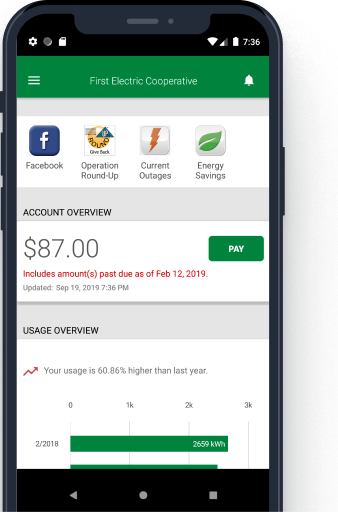
First Electric App
Download the app
Pay My Bill
Billing Options
First Electric App
Download the app
Electrical Service
Net Metering
First Electric App
Download the app
First Electric App
Download the app
Energy Savings Opportunities
Smart Energy Home

First Electric App
Download the app
First Electric App
Download the app

First Electric App
Download the app
First Electric App
Download the app
First Electric App
Download the app
Energy Savings Opportunities
Smart Energy Home
First Electric App
Download the app
First Electric App
Download the app
First Electric App
Download the app
Net Metering Update: This page has been updated to reflect the Net Metering Rules adopted by the Arkansas Public Service Commission (PSC) on September 29, 2023, to conform to Act 278 of 2023, the Arkansas Cost-Shifting Prevention Act (CSPA).
Please review and familiarize yourself with the Arkansas Public Service Commission’s Net Metering Rules and the Cost-Shifting Prevention Act of 2023.
Rule 3.01(A) requires the utility customer and owner of the Net-Metering Facility to execute a Standard Interconnection Agreement prior to interconnecting a solar array to the utility's facilities. All forms reference in the Net Metering Rules are available in the Downloads section at the bottom of this page.
Complete the Application for Preliminary Interconnection and Site Review Request.
*For any questions, please call 800-489-7405 to speak with a Marketing representative.
A First Electric marketing representative will contact you to provide design drawings or specifications from the manufacturer. If needed, First Electric will schedule your preliminary site visit.
For generating facilities not greater than 25 kW, a standard one-time fee of $320 to recover administrative and related interconnection review costs must be remitted prior to interconnecting the net metering facility.
If the cooperative determines a facilities study is necessary, you will be responsible for paying a deposit to recover estimated interconnection study costs. Any portion of the deposit not actually incurred by the cooperative as a result of the study will be promptly returned to you or credited towards the cost of upgrading or adding facilities necessary to safely interconnect the net metering facility.
If any facility upgrades are required, the cooperative will provide you a facilities agreement for your signed approval.
Failure to notify the cooperative prior to purchasing or constructing a net metering facility does not relieve you from paying the administrative fee and the actual cost of a facilities study or system upgrades.
At least 30 days prior to connecting, submit the Standard Interconnection Agreement for Net Metering Facilities and Net Metering Facility Ownership Affirmation found in downloads below. Part I, Standard Information, Sections 1 through 5 of the Standard Interconnection Agreement must be completed.
Section 5 requires certification by an electrical inspector who is licensed by the Arkansas Department of Labor. First Electric does not provide inspection services for net metering facilities.
Please note that Agreement must be received by First Electric at least 30 days prior to connecting.
* The Standard Interconnection Agreement for Net Metering Facilities and Net Metering Facility Ownership Affirmation will NO LONGER be accepted at NetMetering@fecc.coop.
First Electric will schedule the site visit to commission the net metering system. In some instances, First Electric may authorize a qualified individual to commission the net metering system. The qualified individual must be a professional engineer, licensed electrician, or NABCEP-certified individual hired by the member or the member’s contractor. The interconnection MUST be left disconnected and out-of-service until the system is commissioned.
Upon approval, the Standard Interconnection Agreement will be signed by First Electric, and your account will be set up for net metering. Please review the FAQ below, especially the information on how bills will be handled with your account.
Net metering is the process of measuring the difference between electricity supplied by First Electric and the electricity generated by a grid-tie facility and fed back to the cooperative over the applicable billing period.
Several companies provide turn-key net metering equipment and installation. Because the equipment is owned by the member, First Electric cannot recommend any particular brand or installer. However, First Electric does recommend the member contact a marketing representative at 800-489-7405, prior to purchasing any grid-tie equipment to ensure the system is compatible with net metering. For solar systems, First Electric recommends using an installer licensed for skylights and solar systems by the Arkansas Contractors Licensing Board.
In addition to applying for service through First Electric Cooperative, members who purchase a net metering facility must complete the Net Metering Facility Transfer of Agreement and Ownership Affirmation form (see Downloads below).
For net metering facilities interconnected before September 30, 2024 (legacy net-metering), net metering customers are given full retail rate credit (1:1) for any excess kWh fed back to the cooperative during the billing period. Any excess kWh generated by the net metering facility will reverse the kWh on the electric meter. All First Electric meters are capable of running backward; a meter exchange may be required for a service to be net metered. If the electricity generated by the net metering facility is fed back to the cooperative and exceeds the electricity supplied by the cooperative during the billing period, then the member will receive a kWh credit for the accumulated net excess kWh to apply to next month’s bill. Credits may accrue from month to month and do not expire. The kWh credit will be maintained in First Electric’s billing system. The member will continue to receive a monthly bill which includes the service availability charge and minimum bill amount (even if no electricity is purchased).
For net metering facilities installed after September 29, 2024 (non-legacy net-metering), net metering customers will be given credit at the avoided cost of energy for any excess kWh fed back to the cooperative during the billing period. The electric meter will have two channels: Channel 1 for measuring the energy supplied to the electric service from the cooperative, and Channel 2 for measuring the excess kWh fed back to the cooperative during the billing period. Channel 1 will be billed at the cooperative’s tariffed rate. Channel 2 will be credited at the avoided cost of energy from the prior year as filed with the PSC by Arkansas Electric Cooperative Corporation. If the electricity generated by the net metering facility is fed back to the cooperative and exceeds the electricity supplied by the cooperative during the billing period, then the member will receive bill credit at the avoided cost on next month’s bill. Channel 2 kWh credits may accrue from month-to-month and do not expire. The kWh credit will be maintained in First Electric’s billing system. Bill credit for excess kWh only applies to the energy charge on the bill and cannot be used to reduce the service availability charge, demand charge, taxes and fees, or other charges.
If a legacy net metering facility is metered with a two-channel meter, Channel 2 will be credited at the Channel 1 tariffed rate.
At the request of the member, monthly excess kWh credits may be transferred to additional accounts in a rank order provided by the member. The additional accounts must be in the name of the member who received the kWh credits from a net metering facility. An account receiving credits from a non-legacy net metering facility must be within 100 miles of the net metering facility. The member must provide the rank order of additional accounts at least 30 days prior to the first requested transfer, and the member only can make changes to the rank order one time in the calendar year. (See Net Metering Account Transfer Request form in Downloads below.) If the additional accounts are not in the same billing cycle as the net-metered account, those accounts will be moved to a common billing cycle. The additional accounts do not have to be the same class of service. Excess kWh credits will be applied to the additional accounts up to the amount needed to net zero the kWh usage on each account in the rank order provided. Credits applied from legacy net metering facilities will be the cooperative’s tariffed rate for the account receiving the credit. Credits applied from non-legacy net metering facilities will be the avoided cost of energy. Credit kWh will not be divided proportionately across the additional accounts, and the additional accounts cannot carry forward credit kWh from month to month. If the member has multiple net metering facilities, each net meter facility must have its own rank order list of additional accounts. An account only can be assigned to one rank order list. Excess kWh credits do not expire. For legacy net metering facilities, credits older than 24 months may be cashed out at the avoided cost of electricity if the sum to be paid is at least $100.
The net metering system is required to meet all local and national electrical codes, including National Electrical Code, the Institute of Electrical and Electronics Engineers, the National Electrical Safety Code and Underwriters Laboratory. For solar systems, the inverter must be UL 1741/IEEE-1547 compliant. First Electric assumes no liability or responsibility for the installation or operation of the net metering system because the cooperative does not inspect the equipment, wiring or installation beyond the interconnection to the meter. Member must submit a design drawing and product literature for First Electric’s approval prior to the installation. Please contact a marketing representative at 800-489-7405, for more information.
The member must complete and submit a copy of the standard interconnection agreement and ownership affirmation (see Downloads below) at least 30 days prior to the planned interconnection. Part I, Standard Information, Sections 1 – 5 must be completed in its entirety by the member. Section 5 of the standard interconnection agreement requires certification by an electrical inspector who is licensed by the Arkansas Department of Labor. First Electric does not provide inspection services for net metering facilities. The interconnection agreement will be signed at the time the system is commissioned by First Electric. Once the equipment is installed, the member must contact First Electric to schedule a site visit for First Electric personnel to commission the installation. The net metering equipment must remain disconnected from the electric meter until the system is commissioned by First Electric. First Electric will verify two things at the time of the site visit – that the net metering equipment disconnects from the electric meter during a power outage and that the electric meter runs backward when the net metering equipment is feeding back to the cooperative.
Excess kWh credits carry forward from month-to-month and have no cash value until applied to a future billing cycle. For legacy net metering facilities, excess kWh credits older than 24 months may be cashed out at the avoided cost of electricity if the sum to be paid is at least $100.
Members with questions on net metering or the approval process may contact a marketing representative at 800-489-7405.

 Pay My Bill Online
  My Account